It is sweeter to wander with the wretched and outcasts than to sit crowned with roses at the banquets of the rich
Elisee Reclus

Monday, August 07, 2006

Saved from a fragment found in a file...

'Radical sex...I do not simply mean sex which differs from the norm of heterosexual, vanilla, male-dominated intercourse. Being a sex radical means being defiant as well as deviant. It means being aware that there is something unsatisfying and dishonest about the way sex is talked about (or hidden) in daily life. It also means questioning the way society assigns privilege based on it's adherence to its moral codes, and in fact makes every sexual choice a matter of morality. If you believe that these inequalities can be addressed only through extreme social change, then you qualify as a sex radical...(even if you prefer to get off in the missionary position)'

Pat Califia 'It Is Always Right To Rebel' in Public Sex

I Wish To Be Everything and Nothing: Part Two

'I am nothing. I must be everything' MARX

NOTHING
In The Tower, this quotation sits as the front cover of some old magazine or another that I have not moved from a shelf for some time. In this way, I am constantly remindind of the leftist project to be All. Materialisticly, this may make some sense in a world where the richer ones continuously take from the poorer ones. In every other sense, I have no desire for all, for total perfection or for conclusion. It's a beautiful sentence from another time in the world. Despite the horrors of capitalism, we are never merely 'nothing' for we have always been more than that. I'm not sure you can really act from nothing. Our refusal of alienation must stem in mind and body from always knowing and feeling that we are more than mere 'nothing'.

What seems to bother me more in this tradition is the insistence or the contest to be everything. I have learned to rid myself of the use of the word 'should' and all it's striving. 'I must', 'I should'. ('I wish' even?). Why? Because it's a path to failure. Because it's likely to be one-step removed from desire, or better, from will. It's a kind of negative energy. 'I must do something about....', I should learn HTML...'. The pains that result from the failure to do something you 'should' have done are heavier than the wry failure of not doing something you 'want' to do. Often, we only think we 'should' do things that really we have little real desire to do.


EVERYTHING
Similarly the notion of being 'everything' can be criticised. Within the pages of 'SUCK MY THEORY: A Journal of Busty Marxism', two 'lesbians' paw each other while they both annouce: 'I am nothing. I am everything' in refutation of The Master's dictum. When this page was shown to someone (over)interested in Marxist theory, they replied 'They should be saying 'I am nothing. I must be everything''. Obviously a journal of Busty Marxism was not for them. This may indicate why I have no wish to be everything in Marx-ist society especially when I am trying right now to grasp the deep reality that we are all already everything in this very moment. This is manifest anywhere where we play, act, bond and share in moments of autonomy, the project and actualisation of our self-creations. Perversely, in these limitless moments, we feel the beautiful weightlessness of being nothing. Of being collectively nothing.

When we 'go to see' (see Part One) what we see is all and it is nothing. We see object, we see history all around, we see poems written underhand. We may see mystery, for poverty undermined. We may look for spirit and matter at a harmonious level. We may be on the look out for the reflection of the sights all and nothingness on ourselves.

'As I walked down Baker St one night I actually looked for Sherlock Holmes address forgetting completely it had been just a fiction in Conan Doyle's mind'

Jack Kerouac 'Desolation Angels' (1956)

Here Kerouac forces himself to be all when it's more pleasant to just look (in joyful and silly hope) for the residence of Mr Holmes. A few months earlier on 8th August 1956 on a Californian mountain top Kerouac was waiting to see 'the face of reality', almost insisting that his present time and space, solitude and thoughtfulness would be the right conditions for some such revelation, that he 'should' under these circumstances see what was real. In the end, his fantastic thought (immanent reality) was 'eat your prunes...you have been forever and you will be forever' which is why looking for the home of Holmes makes perfect sense.


Everything and nothing for all.
Like the fragments of The Tao that are necessarily returning in these times within radical politics and philosophy, we have to move towards the feeling that we have NOTHING TO PROVE, as both individuals and collectively. Being nothing, not 'this' or 'that'.

(So, maybe, I move towards you as neither 'lover' or 'friend', but as something that we do not know what it is...and maybe never will).

What could actually be better than 'I am everything and I am nothing' in the realm of possibilities for all our amusing subjectivities. For consuming and then devouring in playful fashion all the identites we want to be. I want to destroy the encodings of identity that are so tricky to escape. Or I want to decode them as a game we all play.


Who are you today Ruinist?
Today, I am still The Ruinist.

(In this sense, what I write, what I have to say here, is not 'true' but is still part of how I think and feel.)

And again! What could actually be better than 'I am everything and I am nothing' against the striving logic of coherence, linear living always towards the impossible perfection of an EVERYTHING. Career? Relationship? Security?..but more so 'being happy', the mythical state of 'All' that denies turbulence, feedback, multi-versal realities. (So if I approach my books in this way, it feels more like the process of living with it's twists and turns and dead-ends than some simple A to Z map. In trying to grasp what is being said by 'thinkers' there's more fun to be had in the grasping than in the ticking off of theories digested and completed, any Eureka moment. The wry line from 'My Philosophy' by KRS-1: 'So you're a philosopher. Yes..I think very deeply' is a good joke on not seeing that life itself, in actuality, is the deep that we blur by thinking too much about it).

In terms of alienation, I want to be NO THING. On the addiction to 'I", I want to EVERY 'I'.

It is often asked: 'What do you do?' What can you say? 'I am a writer'. I am not a 'writer' except that I 'write' in this one moment of pressing keys on this shonky keyboard.


I have now substituted my proud and snotty teenage answer to this question, 'Nothing', with the far better, 'What Do You Do?' - 'WHY, EVERYTHING!'

'We must find a way of getting in touch with the self - looking, feeling - already that puts us in touch'
'Aren't you afraid of getting bored in the long run?'
He laughed heartily
'I'm quite accustomed to that; being bored isn't so very boring'

Simone de Beauvoir, "The Blood of Others' (1945)


This cute exchange seems to be apt in some weird to many of the above themes and ramblings, although not immediatley. It follows on from a nasty slag off where a character flushed with pride from addressing a crowd of trade unionists is brought down by the comment...

'Look at her, she thinks she has done something'.

But this too seems also fitting to these themes if we are too escape the miserable trap of who we are as what we do.


Every Exit Made Possible...
Our Exodus, our way out of this, is not in striving, is not in setting up contest.

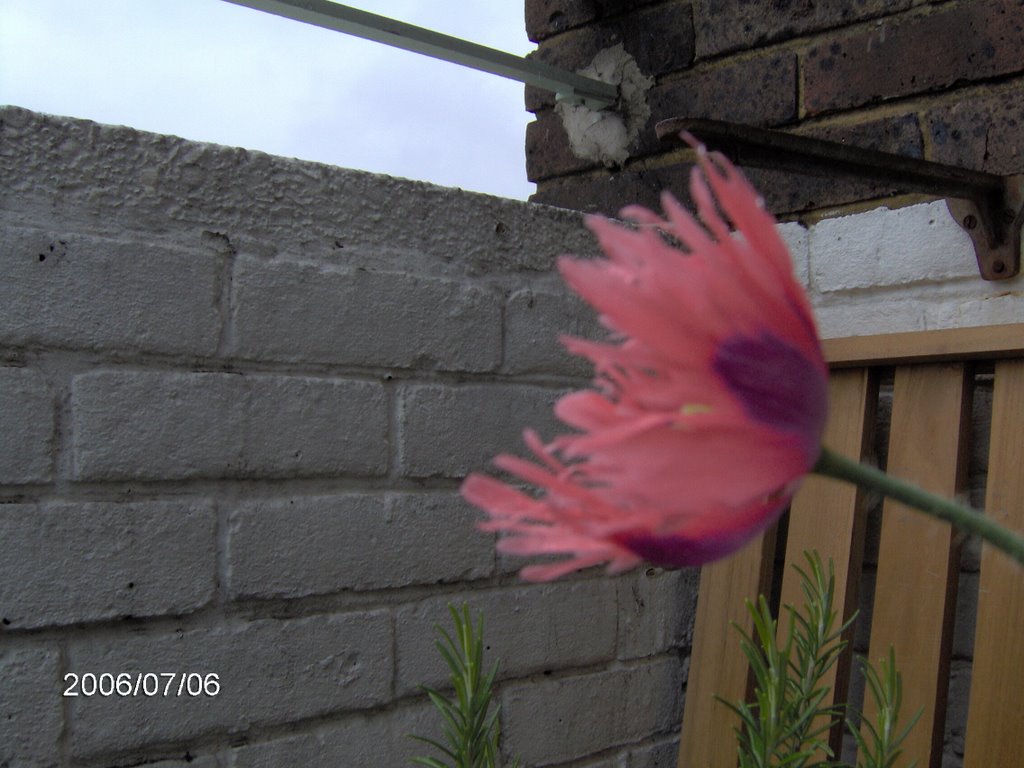
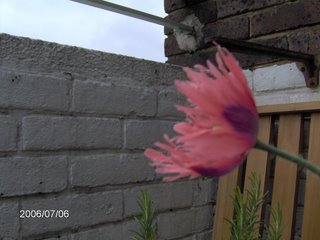
More famous and from the same Marx essay referred to above, is his one-liner 'Religion is the opium of the people'. I grow poppies on my balcony in the same spirit as I 'go to see', with numerous reasons and intents.

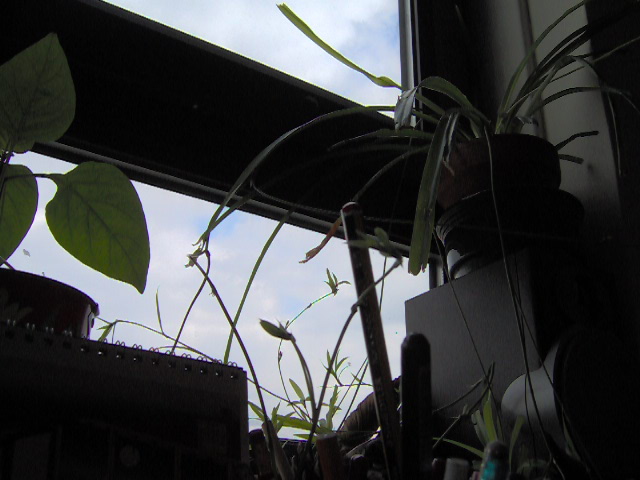
The poppies on my balcony have already been and gone I'm afraid (but are captured here on my own perfect visual insistence). They are gone as plants but remains as decorations in house, as seeds for next years growing, as poppyheads for soothing drinks, as memorial delights, as Marxist metaphor, as connections to great books, as longings for absent friends...

Next year, I hope you will 'go and see' the poppies on The Ruinist's balcony because one day the pretty flowers appear overnight and then just as quick they are gone...like ourselves, as everything, as nothing.


'Close your mouth, block off your senses, blunt your sharpness, untie your knots, soften your glare, settle your dust. This is the primal identity.
Be like The Tao. Itcan't be approaches or withdrawn from, benefited or harmed, honored or brought into disgrace. It gives itself up continually. This is why it endures'

Lao-Tzu, 'Tao Te Ching (The Book of The Way)', (4th Century BC)
I Wish To Be Everything and Nothing: Part One


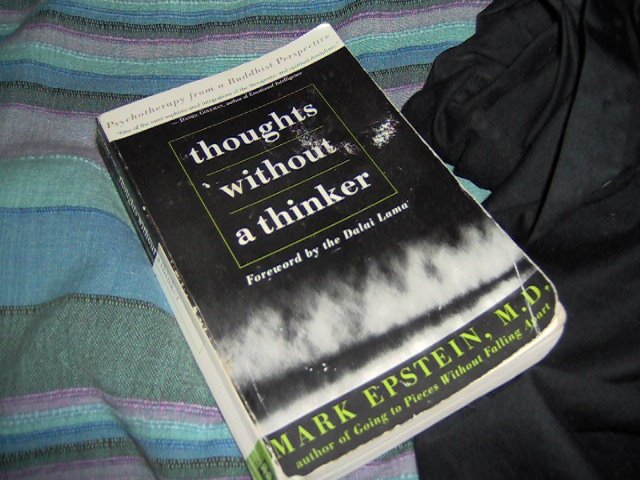
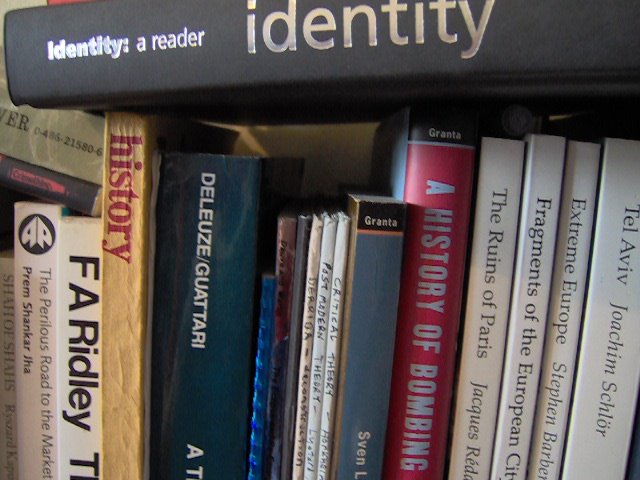
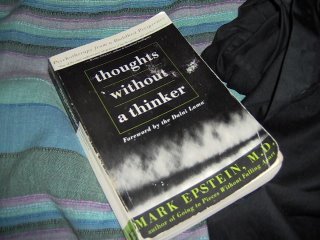
In The Tower where I dwell, books line the walls, on shelves above this desk, on a shelf by the bed. The first thing I see when I wake up is an attack of spines.

I can't say I have really grappled with all of these deep philosophical works. More likely I have spent years embracing them as any English person receives with difficulty any non-Englander who will embrace them with often two or more kisses to the cheek.

Why should I waste my limited time by understanding completely what is being said in these books as opposed to a more suitable approach where through a process of scavenging, pillaging, ripping and tearing, misunderstanding, mangling, boredom, rushing and running I arrive at something more akin to living what is said than just having understood and remembered what was there on the page?

I guess I feel no great need to buffer up my defences by using what is said in big books as a moat for my own insecurity (but I have played this game in the past) . Rather I would like to read as much as I can bare but still enjoy it in my own wacky fashion, purely to break down my self-defences.

My Dad always enjoys how middle-class people would be interviewed on 'tell-a-vision' sitting in front of their bookshelves to indicate that this person knows a thing or two. Equally enjoyable was our uncle who on building himself some bookshelves in a new house, set off to town to buy 'a yard and a half of books'. Enjoyable in a kind of both sides of the same coin sort of way.

The often overheard saying 'They know what they are talking about' often only means that the person is able to talk about things they know about but have not actually experienced.

In books, as in our lives and loves, we will find everything and nothing. Read on..


Reading towards freedom? Seeing towards freedom?
Is it fair for me to oppose TEXT & READING versus GOING & SEING? I'm sure these could all be blended together to produce wonderfully harmonious immediacies resulting in speed and madness towards this goal of 'freedom'.

Despite the everyday unconscious use of all our senses (chip shop smells, the warning sound of approaching cars and so on), there is a sensual unbalance that favours The Eye. This seems to be a modern day insistence on visuality, of things to be seen. Alongside the more obvious and everpresent advertising, I'm also thinking of travel and it's 'what can be seen!' as well as the consumption of entertainment such as live shows, public art and civic displays of endurance and celebration (The Marathon, fireworks displays...) Everything is ready to be seen. Everything must be displayed. It may be true that we are now also expected to display OURSELVES (which might explain the phenomenon that everyone seems to be 'performing' these days, as my friend puts it. Putting on a show on the bus, in shops and bars.)

This public visuality is an overloading without much of a choice of what to see.

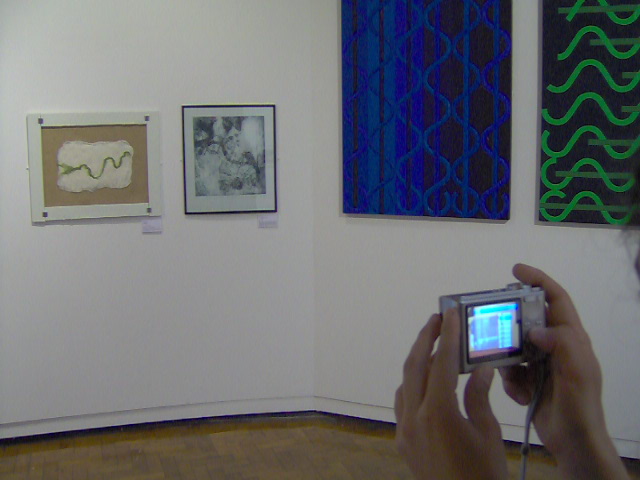
More putting the eye before the nose, ear, tongue or or skin, is the increase in picture taking via small personal objects such as phones or digital cameras and their virus like spreading through the symbiotic machinery of The Internet. In this flash of picture taking, have we lost the moment to the image or are we simply making another moment? Another more overladen and complicated moment? Today I saw a newspaper image of Tamin, a Hizbullah fighter, walking around a bombed out Bint Jbeil with a gun, bottle of water and a mobile phone. Looking for a mosque to pray in, he stops in a ruined square and takes a picture on the phone of the destruction. With a checked shirt on and a baseball cap, he looks like a tourist on holiday. It's impossible to know what moment is represented here. What moment that, via photo or photo-messaging, becomes a future. Or a past.


'I wonder how people remember things who don't film, don't photograph...How has mankind managed to remember? ...The new Bible will be an eternal magnetic tape of a time that will have to reread itself constantly just to know it existed'

Chris Marker 'Sans Soleil', (1983)


Fantastic Vision
What remains of that beautiful freestyle of vision, of picking out, of detecting? Of clues and deja-vu. Of double-takes and mistaken identity? These something more than standard street visuals are taken as deviations against the sense of time/space that is regulated by the insistence of billboards, newspaper headlines, invitations to 'see' and the list of what is best seen - holiday sun, skinny women over made-up, sporting 'events' or remote parts of the planet accesible only by route of money.

What we can choose to see in opposition to this list (to un-seeing?) reminds me of the great line 'move on, there is nothing to see here...' at scenes of control, novelty, panic, disaster or death when all else around has been over-seen, isn't it these scenes that precisely we do want to see (without consuming). To be part of the crowd and not just the wo/man in the crowd? To help out maybe and put our common-ist sense into play?

But this cannot be entirely what I mean. There is something more...


'I Was Going To See and I was Happy'
'Going to see' is my favourite activity. If we are forced to be active people then a little detective work from that what was overheard or picked up in books, what was rumoured or that which you've just worked out psychogeographically, will suit us fine.

In our realm as a little collection of sociable hermits seeking the hermetic view of life and the process of living, then all the best sympathies and correspondences should be sought out (with eyes but more so with heart). I have seen the chickens in the public park at Trieste but I have not been in the the alleged Bar in the Central Post Office. I have read of this wonder in the book 'Trieste and The Meaning of Nowhere' and I want to return. I also desire to see the chickens again to believe that I really did see them. I have also seen the railway tracks that remain along the seafront although no trains now take heavy goods from one part of town to the other. I found these and was happy, their existence made real by one line in the abovementioned book. I climbed upon the see-saw once more...as when I saw the clock in Swanage or the tomb in St Leornards, the monument in Paris or the statue in Rome.

Upcoming but lazy 'going to see' excursions must include the Masterman memorial in St Giles Church, Camberwell, an engraved tablet made by Eric Gill, such a sighting encompassing my postcode, my Tower, typography, incest and hermits. Here again stands our desire for everything and nothing.

I say 'lazy' because these are not missions but whims. Might go today, maybe not...

The best movie in the world so far, having seen all movies so far made, is Chris Marker's 'Sans Soleil'. Being a collection of seeing things, of things seen, things to be seen. It might give clues to what is said here. Seeing at the level of the human and not the thing. It is not a film to watch lightly, expectantly. Sheer density of image and narration makes it something out of this current simplistic world. Better to watch 5 minutes of it 50 times, than 90 minutes of it once. The same movie but the opposite to 'Sans Soleil' is probably the equally incredible vision of Werner Herzog's 'Fata Morgana' which contrasts Marker's warm glances with Herzog's insistent performance and uncomfortably long stares.

Best to come across these movies than rush out to acquire them...(as things?)